
Explainervideos

The bigger topics, explained simply in a few minutes, with pictures instead of long text. Pick a video, press play, and open the key moments or the transcript if you prefer to read.

Where your money really sits, video thumbnail 4:45
Explainer, 4:45

Where your money really sits

Your money lives in two places: your own Dynamic Wallet, which only your private key opens, and your card, which you top up with what you plan to spend. Also covers stablecoins, networks, the 3.9% top-up fee and who is behind the card. Narrated by MTG with his AI voice.

Open How It Works

What you will learn

  • Your money lives in two places: your wallet and your card
  • Your Dynamic Wallet as a safe that only your private key opens
  • What goes in: USDT and USDC, the networks, and swapping other coins
  • The top-up and the 3.9% fee, added on top
  • Who is behind the card: Malta, Singapore and Fireblocks
Key moments
  • 0:00 Welcome: where does my money sit, and is it safe?
  • 0:24 Two places: the safe at home and the card in your pocket
  • 0:41 Your Dynamic Wallet is yours: non-custodial, on Fireblocks
  • 0:58 Only you hold the key: export it, write it down, never share it
  • 1:30 What goes in the safe: USDT and USDC stablecoins
  • 1:41 Networks: BNB Smart Chain, Tron and Ethereum, and swapping other coins
  • 1:56 No crypto yet? VALR or Binance, and BNB for network fees
  • 2:06 Your card: a US dollar card account you can use anywhere
  • 2:19 The top-up and the 3.9% fee, added on top
  • 2:30 Where card money sits, and why you move only what you spend
  • 2:44 Who is behind it: Malta, Singapore and Fireblocks
  • 3:23 The whole flow, from exchange to payment
  • 3:37 Quick recap
  • 3:55 Your turn
  • 4:19 Thank you
Read the transcript

Hi, my name is MTG, Your Digital Architect. Thank you for taking the time to watch this training. The first question almost everyone asks me about the Bellver Card is a good one. Where does my money actually sit? And is it safe? In the next few minutes, I'll show you exactly where your money lives, who holds the key, and how it moves from your wallet to your card. Let's get started.

Here's the big picture. Your money lives in two places. Place one: your Dynamic Wallet. Place two: your card. Think of your home. You keep your savings in a safe at home, and you only carry what you need for the week in your pocket. Your Dynamic Wallet is the safe. Your card is your pocket.

Let's open the safe. When you register, Bellver automatically creates a Dynamic Wallet for you. It runs on Fireblocks wallet technology. And it's non-custodial. That means the wallet belongs to you, not to Bellver. Bellver says it cannot freeze your wallet, and cannot touch your funds.

So what opens the safe? Your private key. Only you hold it. You can export it any time, and move your funds to another wallet if you ever want to. But here's where the safe example stops. A real safe has a locksmith. Your wallet does not. There's no bank to call if you lose your private key. So write it down, keep it offline, and never share it. Not with support, not with me, not with anyone. Then add a transaction password, and two-factor authentication, or a passkey. Tutorials 2 and 3 show you exactly how.

What goes into the safe? Stablecoins: USDT or USDC. A stablecoin is designed to stay worth about 1 US dollar, so your balance doesn't jump up and down like Bitcoin. Send them from any exchange or wallet. BNB Smart Chain is the recommended network, because it's cheap. Tron and Ethereum work too. Already hold Bitcoin, Ethereum or Solana? Deposit them, then swap to USDT or USDC inside your wallet. No crypto yet? Open an exchange account, like VALR in South Africa, or Binance in most other countries. And keep about $10 of BNB in your wallet, for network fees.

Now your pocket: the card. Your card is a US dollar card account. You can pay in shops and online, anywhere in the world, in the local currency. Money only reaches your card when you move it there. That's called a top-up. Each top-up has a 3.9% fee, added on top. Load $100, and $103.90 leaves your wallet. The minimum top-up is $10. Once money is on your card, it sits in your card account, with Bellver's card provider. So move only what you plan to spend, just like taking cash out of the safe for the week. Everything else stays in your wallet, under your own key.

So who's behind all this? Bellver Markets Limited, based in Malta, runs the program and the rewards. Bellver describes itself as the marketing company. It does not hold your money. The card is registered in Singapore, one of Asia's leading financial centres. At the launch webinar, Bellver's head of operations in Singapore said the card provider is licensed by the Monetary Authority of Singapore, and that the wallets run on Fireblocks. The platform launched as version 1.0 in September 2026, and improvements are still rolling out. Don't just trust me. Check the official documents and the launch webinar on my guide, then decide for yourself.

Let's put it all together. Your exchange sends USDT, on BNB Smart Chain, to your Dynamic Wallet. Your safe, your key. When you want to spend, you top up your card. Then you pay, with your card, your phone, or a ring.

Quick recap. Your money lives in two places: your wallet, and your card. Your wallet is yours alone, and only you hold the key. Fund it with USDT or USDC on BNB Smart Chain. Move to your card only what you plan to spend. And protect your private key like the keys to your house.

Well done. Now you know exactly where your money sits, and that puts you ahead of most people who ask. It's your turn. Open your dashboard, find your Dynamic Wallet, and check that your private key is backed up safely. And once you understand it, explain it to someone else. That's how we learn best. If you still have questions after watching this, contact me, or the business partner who shared this video with you.

Quick reminder: none of this is financial advice. Always do your own research. Thank you for tuning in, and for every like, share, and comment. Your support means everything. And thank yourself for taking massive action today to change your future! I wish you nothing but the best, because YOU are the best. I'm MTG, Your Digital Architect. See you on the next one. Let's Get This Crypto!
Which card is right for me?, video thumbnail 4:39
Explainer, 4:39

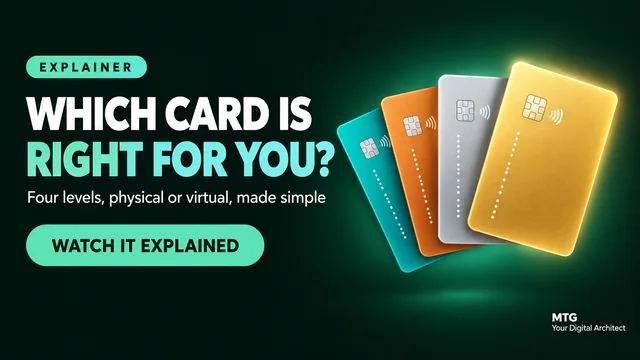
Which card is right for you?

Basic, Premium, Business or Gold, physical or virtual, and the extras: the same card in four sizes, with spending limits, rewards depth, prices, upgrades and fees made simple. Narrated by MTG with his AI voice.

Open Prices & Limits

What you will learn

  • Same card, four sizes: what changes between the levels
  • Spending limits, shown as shopping trolleys
  • Rewards depth, shown as a lift, and the $100 a month rule
  • Physical or virtual: Visa or Mastercard, ATMs, shipping and delivery
  • Upgrades, the Special Edition and the fees
Key moments
  • 0:00 Welcome: which level, physical or virtual, and the extras
  • 0:21 Same card, four sizes: one-time price, no monthly card fee listed
  • 0:40 Spending limits, shown as shopping trolleys
  • 1:09 Rewards depth, shown as a lift: Premium 12, Business 15, Gold 20
  • 1:30 The $100 a month rule: not a subscription, your own money
  • 1:42 Which level is for you, and when referrals cover your card
  • 2:12 Upgrading later: pay only the difference
  • 2:29 Physical or virtual: Visa or Mastercard, ATMs, shipping and delivery
  • 3:08 Extras: the Special Edition and your name on the card
  • 3:25 The usage fees on every level
  • 3:37 Quick recap
  • 3:53 Your turn: the Payback Calculator
  • 4:12 Thank you
Read the transcript

Hi, my name is MTG, Your Digital Architect. Thank you for taking the time to watch this training. Basic, Premium, Business or Gold? Physical or virtual? And what is the Special Edition? In the next few minutes, I'll help you choose the right Bellver Card for you, without guessing. Let's get started.

First, the good news. All four levels are the same card, with the same app and the same wallet behind it. You pay once, when you buy it. Bellver's price list shows no monthly or annual card fee. Only three things change between the levels: how much you can spend, how deep your rewards can go, and the price.

Let's start with spending. Think of a shopping trolley. A bigger trolley carries more. Basic lets you spend $1,000 a day, and $500 in one payment. Premium: $10,000 a day, $5,000 per payment. Business: $50,000 a day, $10,000 per payment. And Gold: $250,000 a day, and $20,000 in one payment. So ask yourself: what is the biggest payment I will ever make in one go? Choose a trolley that fits it.

Now, rewards. Think of a lift in a tall building. Your card decides how high the lift can go. Basic has no lift. It earns direct commissions only, when people order through your link. Premium can go up to level 12. Business up to level 15. And Gold up to level 20. Your stars decide how many of those floors you have unlocked. And to be paid each month, you load at least $100 onto your own card that month. That is not a subscription, and it is not a fee. It is your own money, on your own card, ready for you to spend.

So which one is for you? If you just want a good card, Basic, at $99, does the job. If you want monthly rewards, Premium, at $270, is the minimum Bellver recommends. Business, at $490, is the most popular choice. Refer 3 people who also choose Business, and the $200 commissions cover your card, with $110 to spare. Gold, at $990, gives you the highest limits and the deepest rewards. Not sure yet? Start where you are comfortable. You can upgrade later and pay only the difference. Basic to Business costs $391, and you keep the same card. Just remember: rewards are not back-dated. What you could have earned before upgrading is not paid later.

Next: physical or virtual? Both carry the same limits and the same rewards. The virtual card is a Mastercard. It's ready as soon as it's issued, there's no shipping, and you can add it to Apple Pay or Google Pay, or an NFC ring, and pay with a tap. The physical card is a Visa. It works for cash at ATMs, with a 2% fee. Shipping is $85 to Europe, or $149 to the rest of the world, and Bellver's terms allow up to 4 weeks for delivery. When you order one, give a complete shipping address, and a valid mobile number from the country where it will be delivered. Without them, the courier can't deliver your card.

Two optional extras. The Special Edition is Bellver's privacy-first version of any level. It costs $370 when you buy your card, or $470 if you upgrade later, so decide at the start. And for $49, you can have your name printed on your card.

And the usage fees, the same on every level: 3.9% when you top up, added on top. 1.75% per payment. And 2% at an ATM.

Quick recap. Same card, four sizes. Bigger levels mean bigger limits and deeper rewards. Want rewards? Start at Premium. Want to start paying today? Go virtual. Need cash from ATMs? Add a physical card. And you can always upgrade later, paying only the difference.

Well done. Now you can choose your card with confidence. It's your turn. Open the Payback Calculator on my guide, pick a level, and see how many referrals would cover it. And once you've chosen, help someone else choose theirs. If you still have questions after watching this, contact me, or the business partner who shared this video with you.

Quick reminder: none of this is financial advice. Always do your own research. Thank you for tuning in, and for every like, share, and comment. Your support means everything. And thank yourself for taking massive action today to change your future! I wish you nothing but the best, because YOU are the best. I'm MTG, Your Digital Architect. See you on the next one. Let's Get This Crypto!
The Bellver 2x2 matrix, made simple, video thumbnail 8:46
Explainer, 8:46

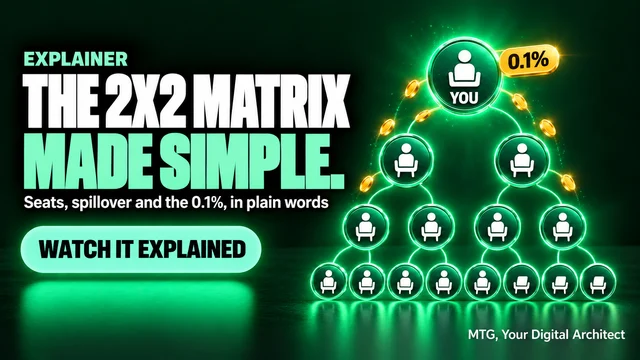
The 2x2 matrix, made simple

An animated explainer in MTG's own voice: two seats under everyone, reading-order filling, spillover, doubling levels, the 0.1% reward, why a 2x2 matrix, star ranks and the $100 monthly rule. Narrated by MTG with his AI voice.

Open the matrix page

What you will learn

  • Why every cardholder has two seats directly under them
  • How seats fill in reading order, like people getting on a bus
  • Spillover, shown as a champagne tower
  • The 0.1% reward, explained with a neighbour and a toll gate
  • Stars, the $100 a month rule and payday
Key moments
  • 0:00 Welcome
  • 0:26 The big picture: two ways to earn
  • 0:52 Step 1: two chairs under everyone
  • 1:11 Step 2: seats fill in reading order (the bus)
  • 1:38 Your third referral: Sipho
  • 1:57 Your team shares too
  • 2:14 Step 3: spillover (the champagne tower)
  • 2:52 Step 4: every row doubles
  • 3:20 Step 5: the 0.1%, a neighbour and a toll gate
  • 4:08 Honest early numbers
  • 4:29 Why a 2x2 matrix? Six reasons
  • 5:53 Step 6: stars decide how deep you are paid
  • 6:35 Step 7: the $100 rule
  • 7:00 Two tips: card first, and payday
  • 7:20 What you need to do
  • 7:40 Quick recap
  • 7:57 Your turn
Read the transcript

Hi, my name is MTG, Your Digital Architect. Thank you for taking the time to watch this training. Grab a cup of tea, sit back, and relax. Today I'm going to explain the Bellver two by two matrix the way I'd explain it to my own family, sitting right next to you. No big words. Just pictures, simple examples, and honest numbers. By the end, you'll say: oh yeah, now I get it. Let's get started.

First, the big picture. Bellver pays you in two ways. One: a direct commission. When someone buys a card through your link, you get paid once. For example, a Premium card pays you one hundred dollars. Two: a monthly reward. Every month, you get a tiny slice of the money that cardholders in your matrix load onto their cards. The matrix is simply the map that decides whose top-ups count for you. So let's draw that map together.

Picture yourself at the top of a page. Under you, there are two empty chairs. Just two. That's why it's called two by two. Every person has two chairs directly under them. The row of chairs right under you is called level one. And here's the rule: only cardholders can sit. If someone just registers, but doesn't buy a card, they don't get a chair.

Now, how do the chairs fill? Think of people getting on a bus. The front row fills first, from left to right. Then the next row. Then the next. Nobody can jump the queue, and no seat is left empty. The matrix works exactly like that. Watch the numbers. Seat one. Seat two. Then the next row: three, four, five, six. Then seven, all the way to fourteen. Top to bottom, left to right. Just like reading a book.

So what happens when your two chairs are full, and your friend Sipho also wants a card? Do you lose him? No. The system sits him in the next free chair, further down, under one of your people. You still get your direct commission for Sipho, because he used your link. And he's still in your matrix, so his top-ups count for you too. Nobody you bring is ever wasted.

Now your people start sharing too. When the person in seat one brings a friend, that friend sits in seat one's free chair. Seat one earns the direct commission, because it's their friend. But look where that friend is sitting. Inside your matrix, on your level two. So their top-ups count for you as well.

This next part is my favourite. It's called spillover. Have you ever seen a champagne tower at a wedding? You pour into the top glass. When it's full, it overflows into the glasses below. The matrix works the same way. The people above you, your upline, are also sharing the card. When they bring more than two people, their extra people flow down into the next free chairs, and some of them land in your matrix. You did nothing for them, and you get no commission for them. But their top-ups count for your monthly rewards. That's help from above. And it's why Bellver says this is not a binary plan. There's no weak side. You get paid on everyone in your levels, left and right.

Now, watch what happens as the rows go down. Every row doubles. Level one has two chairs. Level two has four. Level three, eight. Then sixteen, thirty-two, sixty-four. It's like a family tree turned upside down: two parents, four grandparents, eight great-grandparents. By level twelve, there's room for eight thousand, one hundred and ninety people. By level fifteen, more than sixty-five thousand.

So, where's the money? Every time a cardholder in your levels loads money onto their card, you get zero point one percent. That sounds small, so let's make it real. Say your neighbour loads three hundred dollars onto her card, for groceries and petrol. Zero point one percent of three hundred dollars is thirty cents. Thirty cents goes to you. One person, thirty cents. Now think of a toll gate on a busy highway. One car pays a small coin. But thousands of cars, every single day, add up to a lot of money. If your first twelve levels were full, that's eight thousand, one hundred and ninety people. If each one loaded three hundred dollars, that's about two thousand, four hundred and fifty-seven dollars for you. Every month. That's Bellver's own example. It assumes every chair is full, so treat it as an example, not a promise.

Let me be honest with you, like family. In the beginning, your matrix is small. With fourteen people, it's about four dollars a month. So early on, your direct commissions are the bigger money. Two Premium referrals pay you two hundred dollars. That's almost the price of your own Premium card. The monthly rewards grow slowly at first, and then faster, as your matrix fills.

Now, a big question. Why a matrix at all? Why would Bellver pay people like you and me? Here's why. First, it's a marketing strategy. Most companies spend a fortune on advertising: billboards, TV, and social media ads. Bellver chose a different way. Instead of paying for ads, it rewards the people who use the card and share it. Word of mouth, from people you already trust. Second, where does the money come from? Every time someone tops up a card, there's a small top-up fee of three point nine percent. A part of that fee is shared with the people in the matrix. So the monthly rewards come from real people, using a real card. And remember, the one hundred dollars you load every month is not a subscription. It's your own money, on your own card, for your own life. Third, it rewards the builders. People who share the card and help others get monthly income, again and again, for as long as they stay qualified and keep their chair. Fourth, it's built to last. When a company earns from everyday card use, it can pay its staff, its partners, and its rewards, month after month. That's sustainability. Fifth, it's teamwork. Thanks to spillover, the people above you help fill your matrix, and you help the people below you. Nobody builds alone. And sixth, it's simple to share. You only need two. Two is easy to explain, easy to copy, and easy to teach. That's why it's a two by two matrix.

So, how deep do you get paid? Think of a lift in a tall building. Your card decides how high the lift can go. Your stars decide which floors you've unlocked. With a Basic card, the lift doesn't move. You earn direct commissions only. To get your first star, you need your own Premium card, plus two people you refer directly, who each buy a Premium card or higher. That unlocks twelve levels. With a Business card, and two direct partners who each have one star, you get two stars, and fifteen levels. With a Gold card, and two direct partners who each have two stars, you get three stars, and eighteen levels. Four and five stars go to nineteen and twenty levels.

Now, the one rule that keeps you paid. Every month, load at least one hundred dollars onto your own card. This is not a fee. Think of it like buying your own groceries with your own card. The money stays yours, and you spend it like normal. If you forget for one month, you lose that month's rewards. If you forget three months in a row, you lose your chair for good, and you can't get it back. So set a reminder, and never miss it.

Two quick tips. First, get your own card before the people you refer buy theirs. Your chair only starts when your card is bought. Second, payday is the fifteenth of every month. Rewards arrive in USDT, a digital dollar. You can load it onto your card, or withdraw it once you have one hundred dollars or more.

So, what do you need to do? Five simple steps. One: get a Premium card or higher. Two: load one hundred dollars onto it every month. Three: share the card with two people who buy Premium or higher. Four: help those two do the same. And five: keep loading every month, and let the matrix fill. That's it.

Quick recap. Two chairs under everyone. Chairs fill like a bus, front to back, left to right. Spillover flows down from above. Every row doubles. You earn zero point one percent per level. Stars decide how deep you're paid. And one hundred dollars a month keeps you paid.

Now you understand the matrix better than most people. Be proud of that. Now it's your turn. Play with the matrix on my website, download the free guide, and share this video with your potential business partners. We learn best by teaching. If you're still unsure after watching a few times, contact me, or the business partner who shared this video with you.

Quick reminder: none of this is financial advice. Always do your own research. Rewards depend on real card activity, and are never guaranteed. Thank you for tuning in, and for every like, share, and comment. Your support means everything. And thank yourself for taking massive action today to change your future! I wish you nothing but the best, because YOU are the best. I'm MTG, Your Digital Architect. See you on the next one. Let's Get This Crypto!
Your first week as a partner, video thumbnail 4:32
Explainer, 4:32

Your first week as a partner

What partner means, the one-time commissions, your first star and the $100 monthly rule, a simple 7-day plan, Bellver's promotion rules and how to share the card honestly. Narrated by MTG with his AI voice.

Open Become a Partner

What you will learn

  • What partner means: your referral link is your partnership
  • One-time commissions from $10 to $500 per card
  • Your first star and the $100 a month rule
  • A simple 7-day plan, one small step a day
  • Bellver's promotion rules and how to share honestly
Key moments
  • 0:00 Welcome: where to start, what you earn and the rules
  • 0:21 What partner means: your referral link is your partnership
  • 0:46 What you earn: one-time commissions from $10 to $500 per card
  • 1:08 Your first star unlocks monthly rewards
  • 1:21 The $100 monthly rule, explained in full
  • 1:38 Your first week: a simple 7-day plan
  • 2:44 Bellver's 3 promotion rules
  • 3:09 How to share it the honest way
  • 3:31 Quick recap
  • 3:47 Your turn
  • 4:06 Thank you and see you on the next one
Read the transcript

Hi, my name is MTG, Your Digital Architect. Thank you for taking the time to watch this training. You understand the card. Now you want to share it. But where do you start, what do you earn, and what are the rules? In the next few minutes, I'll walk you through your first week as a Bellver partner, step by step. Let's get started.

First, what does partner mean? Think of a good restaurant. When you love it, you tell your friends. Now imagine the restaurant thanks you every time a friend you sent orders a meal. That's it. There is nothing to apply for, and nobody to sign up with. Your referral link is your partnership. You'll find it at the top of your Bellver dashboard. And here is the good news: Bellver pays your referral commission whether or not you own a card yourself.

So what do you earn? Each time someone orders a card through your link, you earn a one-time commission. $10 for Basic. $100 for Premium. $200 for Business. And $400 for Gold. If they choose the Special Edition, it's more: $150 for Premium, $300 for Business, and $500 for Gold. And unlike a restaurant, there is more. Hold a Premium card or higher, refer 2 new people who each choose Premium or higher, and you earn your first star. That unlocks monthly rewards across your 2x2 matrix. To be paid each month, you load at least $100 onto your own card that month. That is not a subscription, and it is not a fee. It is your own money, on your own card, ready for you to spend. Miss it 3 months in a row, and you lose your matrix position for good.

Now, your first week. 7 days, one small step a day. Day 1: register and secure. Switch on your authenticator app, and write your private key on paper. Never on your phone, never in a screenshot. Day 2, if you want to: fund your wallet and order your own card. Choose virtual, and you can pay the same day. Day 3: use it for real. Pay for something, and load your $100 for the month. Real use gives you something true to talk about. Day 4: learn the numbers. Watch the explainer videos, and read the prices and rewards pages, so you can answer questions without guessing. Day 5: pick your first 2 people. Think of 2 people who would truly value this card. Show them how it works, and don't push. Day 6: help them get set up. Send them the tutorial videos and the Starter Checklist, and stay close while they register. If they order a physical card, remind them: a complete address, and a valid local mobile number. Day 7: check your dashboard. See your registrations, orders and commissions, and learn from what worked.

Before you share a single link, know Bellver's rules. One: big campaigns, and public advertising on social media, need Bellver's approval first. Ask, then publish. Two: be accurate. False or misleading claims, or promises of income, can get your account suspended. Three: referring is always optional. Nobody has to refer anyone to use the card.

So how do you share it the honest way? Say plainly that you earn a commission. Show the card working, not your balance, and never your private key. Lead with the card and what it does for people, not with recruiting. And never promise income. Results depend on real people ordering real cards. If you go live on TikTok, check TikTok's current rules for your country first.

Quick recap. Your link is your partnership. You earn a one-time commission on every card ordered through it. Monthly rewards start with your first star, and your $100 load each month. 7 days, one step a day. And always share the honest way.

Well done. You now know exactly how to start. It's your turn. Open the partner page on my guide, find your link, and pick your first 2 people. And once they're set up, teach them to do the same. We learn best by teaching. If you still have questions after watching this, contact me, or the business partner who shared this video with you.

Quick reminder: none of this is financial advice. Always do your own research. Thank you for tuning in, and for every like, share, and comment. Your support means everything. And thank yourself for taking massive action today to change your future! I wish you nothing but the best, because YOU are the best. I'm MTG, Your Digital Architect. See you on the next one. Let's Get This Crypto!

10 reasons people choose it, and what comes next, video thumbnail 4:18
Explainer, 4:18

10 reasons, and what comes next

The 10 reasons people choose the Bellver Card (your keys, start today, pay once, two ways to order, high limits, pay your way, commissions, a share of the fees, spillover and monthly rewards), the honest part about the fee, and Bellver's roadmap for 2026 and 2027. Narrated by MTG with his AI voice.

Read the 10 reasons

What you will learn

  • Your keys, your crypto, and a virtual card you can use today
  • One-time prices, two ways to order and limits that grow with you
  • Commissions, a share of the fees, spillover and monthly rewards, with the $100 rule
  • The honest part: why the top-up fee is 3.9%
  • Bellver's own roadmap for 2026 and 2027, from version 2.0 to a metal card and an app
Key moments
  • 0:00 Welcome: can your card do this?
  • 0:26 Reasons 1 and 2: your keys, your crypto, and start today
  • 0:48 Reasons 3 to 5: pay once, two ways to order, limits that grow
  • 1:13 Reason 6: pay your way
  • 1:26 Reason 7: share it, and earn a one-time commission
  • 1:37 Reason 8: a share of the fees
  • 1:47 Reason 9: spillover
  • 1:57 Reason 10: monthly rewards and the $100 rule
  • 2:19 What comes next: Bellver's roadmap for 2026 and 2027
  • 2:57 The honest part: the 3.9% top-up fee
  • 3:16 Quick recap
  • 3:32 Your turn
  • 3:52 Thank you and see you on the next one
Read the transcript

Almost everyone already owns a bank card. But can your card do this? Hi, my name is MTG, Your Digital Architect. Thank you for taking the time to watch this training. As reported at launch, more than 1,000 cards were sold in Bellver's testing phase alone. In the next few minutes, I'll show you the 10 reasons people keep choosing the Bellver Card, and what Bellver has planned next. Let's get started.

Reason 1: your keys, your crypto. Your USDT and USDC stay in your own wallet, protected by your private key. You move only what you need onto the card, when you need it. Reason 2: you can start today. A virtual Mastercard is ready as soon as it's issued, for online payments and paying with your phone. Or choose a physical Visa, delivered to your door.

Reason 3: you pay once. $99 for Basic, up to $990 for Gold. A one-time price, not a monthly subscription. Reason 4: two ways to order. Complete a quick identity check, or order without one, for a surcharge. Reason 5: limits that grow with you. $1,000 a day on Basic, all the way up to $250,000 a day on Gold, in any local currency.

Reason 6: pay your way. Add the card to Apple Pay or Google Pay and pay with a tap, shop online, or take out cash at an ATM with the physical card.

Now, the reasons that make this card different. Reason 7: share it, and earn. Each time someone orders through your link, you earn a one-time commission, from $10, up to $500. And you don't even need a card of your own for this. Reason 8: a share of the fees. When cardholders in your paid levels top up, you earn 0.1% per level. That's $1 for every $1,000 loaded. Reason 9: spillover. Only 2 seats sit directly under you. When people above you refer more than 2, the extras flow down into free seats, and some land under you. Reason 10: monthly rewards that grow as your matrix fills. Here's the catch, said out loud: to be paid each month, you load at least $100 onto your own card that month. That is not a subscription, and it is not a fee. It is your own money, on your own card, ready for you to spend. And rewards depend on real card activity. They are never guaranteed.

So, what comes next? Here is Bellver's own roadmap. The test phase started on 9 September 2026, and version 1.0 launched on the 26th. Both are done. Version 2.0 is in progress, planned for January 2027. In March, more products in the shop, with NFC applications. In May, a metal card: Platinum Unlimited, with air miles. In June, Bellver's own app. In October, the goal is Bellver's own Visa licence. And in December, version 3.0. Planned dates and goals can change, so treat them as plans, not promises.

Now the honest part. The top-up fee is 3.9%, higher than a normal bank card, because that fee is what pays the rewards. Bellver's own founder said it at launch: if you only want the cheapest card, your bank's card may suit you better. If you want a card that can give something back, this one was built for that.

Quick recap. Your keys, your crypto. Start today. Pay once. Limits that grow with you. Pay your way. Commissions, a share of the fees, spillover and monthly rewards, with the $100 rule. And a roadmap that keeps moving.

Well done. Now you know why people choose the Bellver Card. It's your turn. Read the reasons again on my guide, check the official documents, then decide for yourself. And when you're ready, share this video with someone who needs a card that can pay their bills. If you still have questions after watching this, contact me, or the business partner who shared this video with you.

Quick reminder: none of this is financial advice. Always do your own research. Thank you for tuning in, and for every like, share, and comment. Your support means everything. And thank yourself for taking massive action today to change your future! I wish you nothing but the best, because YOU are the best. I'm MTG, Your Digital Architect. See you on the next one. Let's Get This Crypto!

Explainers by MTG, narrated with his AI voice. More are on the way.

MTG, Musa The Giant

Want a topic explained?

Tell me which part of the guide is hard to follow, and I will turn it into an explainer, or walk you through it on WhatsApp.

WhatsApp MTG